
How to Choose a Printing Service That Delivers on Time
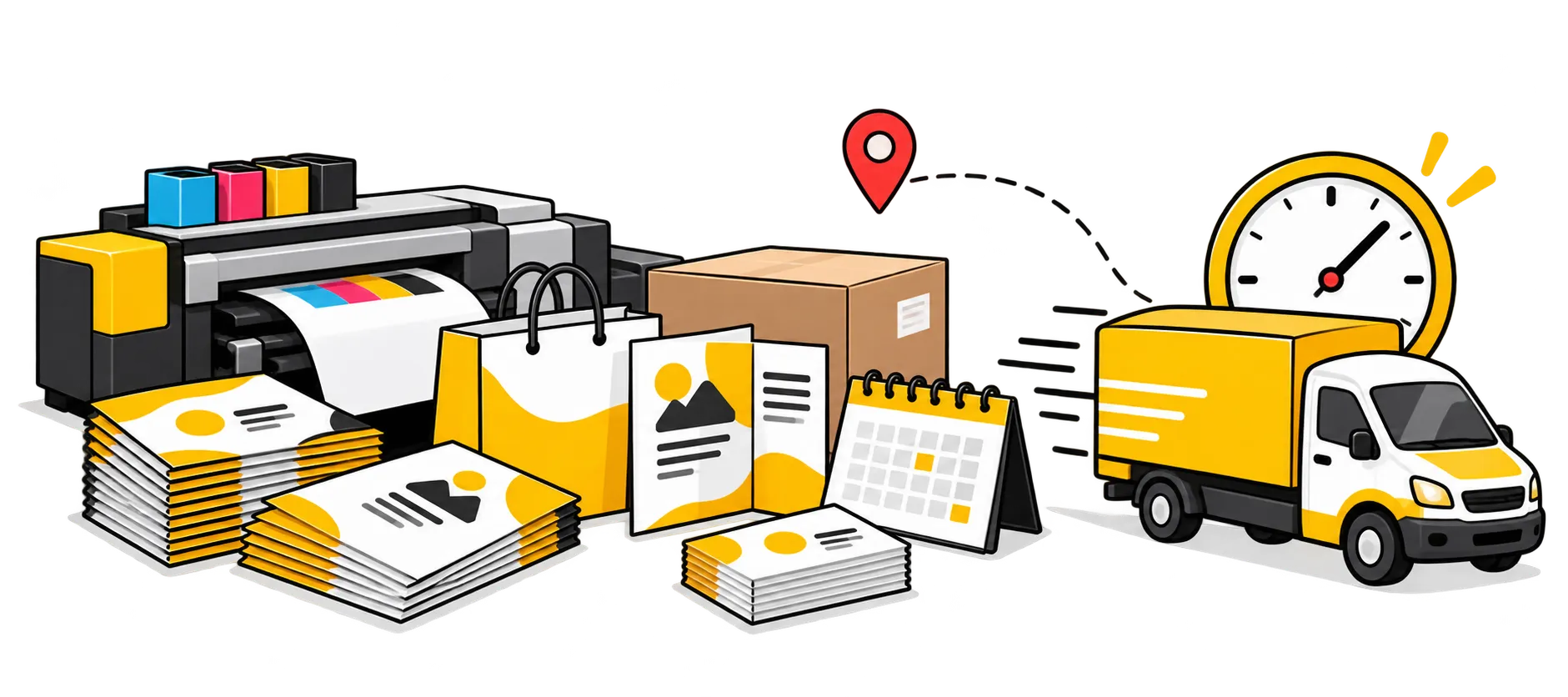
Fast quotes are easy to find. Reliable delivery is not. Here's how to tell the difference between a vendor that promises the right things and one that actually follows through.
You've been there. The event is in three days. The trade show opens Monday morning. The client presentation is Friday afternoon. You placed a print order a week ago with someone who promised delivery "within five working days" and now it's Wednesday, the calls are going to voicemail, and the brochures are nowhere.
Choosing the wrong printing services vendor doesn't just cost you money. It costs you credibility, composure and sometimes even a client. This guide exists so that never happens again.
01 What Most People Get Wrong Before They Even Place an Order
The most common mistake businesses make when searching for a printing company isn't choosing the wrong paper or the wrong finish. It's choosing based on price alone without asking a single question about process, capacity or track record.
A low quote is easy to generate. Any shop can give you a number. What's harder to verify and what actually determines whether your job arrives on time and at the quality you expected is the vendor's workflow, their communication habits and their honest understanding of what your job actually requires.
The businesses that consistently get great results don't always find the cheapest option. They find the most reliable one. And reliability, as any experienced buyer will tell you, is worth paying a premium for, especially when there's a deadline attached.
The Real Cost of a Late Print Order: A missed deadline rarely just means waiting a day longer. It can mean reprinting urgently at a higher rate, showing up to an event with nothing to hand out or apologising to a client for materials that didn't arrive. When you calculate the true cost of a failed job along with lost time, emergency reprints, and damaged relationships, a slightly higher quote from dependable professional printing services suddenly looks like the most economical decision you could have made.
02 Understanding What You're Actually Buying
At their most basic, commercial printing services take your digital file and turn it into something physical like business cards, brochures, banners, packaging, and flyers. But what professional suppliers are really selling you is not ink on paper. It's execution. It's the ability to take your artwork, process it correctly, produce it at the quality you expect and get it into your hands before your deadline.
The industry covers a broad range, from neighbourhood shops handling short runs to large production facilities running offset presses at serious volume. Digital printing services are fast, flexible and ideal for smaller quantities with quick turnarounds. Larger commercial setups handle bigger jobs with tighter colour control and more complex finishing options.
Knowing which type of vendor your job actually calls for is the first step. A shop that's great at fast digital flyers may not be equipped to handle a 5,000-unit brochure run with spot UV finishing. Matching your requirements to the right kind of operation is what separates a smooth experience from a stressful one.
03 Why Print Orders Miss Deadlines — The Real Reasons
Most late deliveries are not caused by a press breaking down or a sudden paper shortage. They're caused by entirely predictable, entirely avoidable failures that happen before a single sheet goes through the machine. Understanding these failure points is the first step to avoiding them.
Where delays actually happen:
- File submission problems: Files submitted at the wrong resolution, missing bleed, with incorrect colour profiles or with embedded fonts missing cause back-and-forth that eats days. A rigorous pre-press workflow catches these immediately. A disorganised shop lets them sit until someone notices, which is often too late.
- Unclear turnaround expectations: "Five working days" sounds clear until you realise the clock starts only after file approval, not when you place the order. Many jobs lose two to three days just in the approval stage before production even begins. Fast turnaround printing means fast from approval, not fast from enquiry.
- Overcommitted vendors: A supplier who says yes to every job regardless of current capacity is one of the most common sources of late delivery. They take the order, push it back in the queue and hope it works out. The most dependable printing services manage their order books honestly and tell you upfront if your timeline is tight.
- Poor communication mid-job: You shouldn't have to chase an update every time you need to know where your job stands. When something shifts, like a stock arrival, a machine issue, or a quality check that needs a rerun, a good vendor tells you before you have to ask. Silence is usually not a good sign.
- No quality check before dispatch: Jobs that bypass a proper final check before leaving the press can arrive with colour shifts, misaligned cuts or binding problems, which means reprints, more delays and a conversation nobody wants to have.
04 Red Flags to Watch for Before You Commit
Some warning signs are obvious only in hindsight. These are the ones worth spotting before you place the order, not after you're chasing a delivery that's already two days late:
- Vague turnaround commitments: "We'll try to get it done by then" is not a delivery commitment. Professional printing services give you a confirmed date in writing and stand behind it.
- No file check or prepress review: If a supplier takes your file without reviewing it for resolution, bleed and colour mode, they're leaving quality entirely to chance. Standards begin at the file stage, not at the press.
- No samples or past work: A vendor who can't show you examples of previous output is asking you to trust them on faith alone. That's a risk not worth taking on an important job.
- The quote is suspiciously low: Competitive pricing is real, but quotes dramatically below market rate usually signal corners being cut somewhere, such as paper quality, output consistency or customer support, which are usually where the savings come from.
- Slow or unclear communication: How a vendor communicates before the order tells you exactly how they'll communicate during it. If getting a quote takes three follow-ups, production updates will be no different.
- No clear process for urgent jobs: If a supplier can't articulate how they handle same-day printing service requests or last-minute deadlines, assume they handle them badly or not at all.
05 What a Reliable Print Partner Actually Looks Like
There are operations that run like well-oiled machines with clear processes, honest timelines, consistent output and the kind of communication that makes you feel like your job is being taken seriously. Here's what separates them from the rest:
- They review your file before confirming the order: A pre-press check that catches resolution, bleed and colour issues before production begins is the single biggest indicator of a professional setup.
- They give you a confirmed delivery date in writing: Not an estimate. Not a "should be ready by". A date they commit to, and a clear protocol if something changes before then.
- They're honest about capacity: The best commercial printing services will tell you when your timeline is too tight and offer alternatives rather than take the order and deliver late.
- They send a proof before production: A digital or physical proof gives you a final look before the full run goes through the press. It's the last line of defence against costly errors.
- They have visible reviews and samples: Previous client work, verified reviews and physical samples tell you far more than a price list or a polished website ever will.
- They communicate proactively: Updates without being asked. A heads-up if something shifts. A team that treats your job the way you treat your client work, with ownership and responsibility.
06 Questions to Ask Before You Place the Order
Most businesses skip this step entirely. They send the file, agree to the quote and hope for the best. The five minutes it takes to ask these questions can save you from days of frustration. Ask them every time, with every new vendor, until you've found a partner you genuinely trust:
- What is your confirmed delivery date for this job—not an estimate, but a date? This tells you immediately whether they're being precise or vague about their commitments.
- When does the turnaround clock start — from file submission or from file approval? The difference can be two to three days on a typical job. You need to know this before you build your timeline.
- Do you do a prepress file check, and what happens if there's a problem with my file? A good vendor catches file issues before production. A poor one discovers them after or doesn't catch them at all.
- Can I see a proof before the full run goes to press? For anything brand-critical or colour-sensitive, a proof is not optional. Any serious printing services operation should offer this as a standard.
- Can you show me samples of similar jobs you've produced? Printed samples tell you more about actual output consistency than any spec sheet or website claim.
- What happens if the job is delayed or there's a quality issue on delivery? A vendor who has a clear answer to this question has dealt with problems before and built a process around them. That's actually reassuring.
07 Understanding Print Costs — What You Should Expect to Pay
One of the most common questions businesses ask before engaging printing services is, 'How much does this actually cost?' The honest answer is that it depends on four things: what you're producing, how many copies you need, what quality of materials you want and how quickly you need them.
As a general rule, fast turnaround printing costs more than standard delivery. Same-day printing service requests carry a premium, sometimes a significant one, because they require a vendor to deprioritise other jobs in their queue. That premium is worth paying when the deadline genuinely demands it. It's worth avoiding when you plan ahead and give yourself a reasonable production window.
What drives costs up and what brings them down:
- Quantity: Larger runs lower the cost per piece, especially in offset production. Bulk printing services work strongly in your favour when you're ordering in volume; economies of scale are significant.
- Paper and finish: Premium stocks, lamination, spot UV and foil all add cost. They also add perceived value, choosing based on what the piece needs to achieve, not just what looks impressive on a spec sheet.
- Turnaround time: Standard delivery is nearly always more economical than rush. Build your schedule with enough lead time to avoid premium charges.
- Artwork readiness: A print-ready file with 300 DPI, the correct colour profile and proper bleed avoids prepress charges and delays. A file that needs work costs time and sometimes money.
- Vendor type: A neighbourhood digital printing services shop and a large-scale commercial operation work at different cost structures. Match the vendor to the scale and complexity of your job.
A Note on "Affordable" Printing: There's a meaningful difference between good value and simply cheap. Good value means fair pricing for the quality and service you receive. 'Cheap' means the lowest number on the quote, often with hidden costs in output consistency, turnaround reliability or customer support. The best operations offer competitive pricing with transparent processes. If the price seems too good, ask what's being traded off to get there.
08 Building a Long-Term Relationship with the Right Partner
The businesses that consistently get the best results from their printed materials are not the ones that shop around for the lowest quote on every job. They're the ones who find a supplier they trust among the available professional printing services, build a relationship and invest in it over time.
When a vendor knows your brand and your colours, your preferred paper stocks, your typical timelines, your quality expectations, the whole process gets faster and smoother with every job. They catch problems before you do. They flag potential issues with new artwork before it hits the press. They prioritise your work because you've demonstrated that you're a reliable client who comes back.
For businesses with ongoing needs such as regular flyers, seasonal campaigns, event materials and corporate stationery, this kind of relationship is one of the most valuable operational assets you can build. It's not glamorous, but it's the kind of thing that means you're never scrambling for a supplier at the last minute.
Signs you've found the right partner:
- They know your brand colours without you having to remind them each time.
- They flag potential issues with your artwork before you ask.
- They're honest when a deadline is tight rather than overpromising.
- Their delivered work consistently matches or exceeds what they showed you in the proof.
- You don't dread calling them when something goes wrong, because you know they'll fix it.
- They suggest improvements: better paper, smarter formats, and more cost-effective run sizes.
When to Switch Vendors: Loyalty is valuable but not unconditional. If your current supplier has missed deadlines twice in a row, delivered output that didn't match the proof or consistently leaves you chasing updates, it's time to find a better solution. The switching cost of finding new commercial printing services is always lower than the ongoing cost of working with an unreliable one.
09 Your Vendor Assessment Checklist
Use this before engaging any new supplier, whether it's a one-off urgent job or the beginning of what you hope will be a long-term partnership. Tick every box before you send the file:
Before You Place the Order — Vendor Assessment Checklist:
- A confirmed delivery date was received in writing, but not an estimate.
- Clarified when the turnaround clock starts (file submission vs. file approval).
- Confirmed they perform a pre-press file check before production.
- Proof is offered before the full production run begins.
- Samples of previous similar work reviewed and approved.
- Pricing breakdown received: paper, quantity, finish, and delivery are all itemised.
- A rush or same-day printing service process is confirmed if the deadline is tight.
- Escalation process is understood about what happens if there's a delay or quality issue.
- Your artwork file is print-ready with 300 DPI, CMYK, and the correct bleed applied.
- At least two to three positive reviews or references are verified.
The Best Printer Is the One You Never Have to Worry About
There's a version of this experience where every job is stressful, where you're chasing updates, hoping the colours are right and refreshing your phone on the morning of the deadline. And there's another version where you send the file, agree on the date and it arrives exactly as expected, exactly when promised.
The difference between those two experiences is almost entirely about the vendor you choose. Not the cheapest one. Not the one with the fanciest website. The one with the right processes, the honest communication and the track record to back up what they promise.
Whether you need bulk printing services for a major campaign, fast turnaround printing for a last-minute event or a dependable supplier for ongoing brand materials, those vendors exist. This guide is how you find them. And once you do, hold onto them. A reliable print partner is genuinely one of the most underrated assets a growing business can have.
"The right supplier doesn't just deliver your job on time. They make sure you never have to wonder whether it will be."
Frequently Asked Questions about How to Choose a Printing Service that Delivers
Ready to Experience Printing Delivered on Time?
Let's discuss how Print Monster can deliver your next project with strict quality checks, guaranteed turnaround times, and express delivery in Chennai.

