
Offset vs Digital Printing: Which is Better for You?
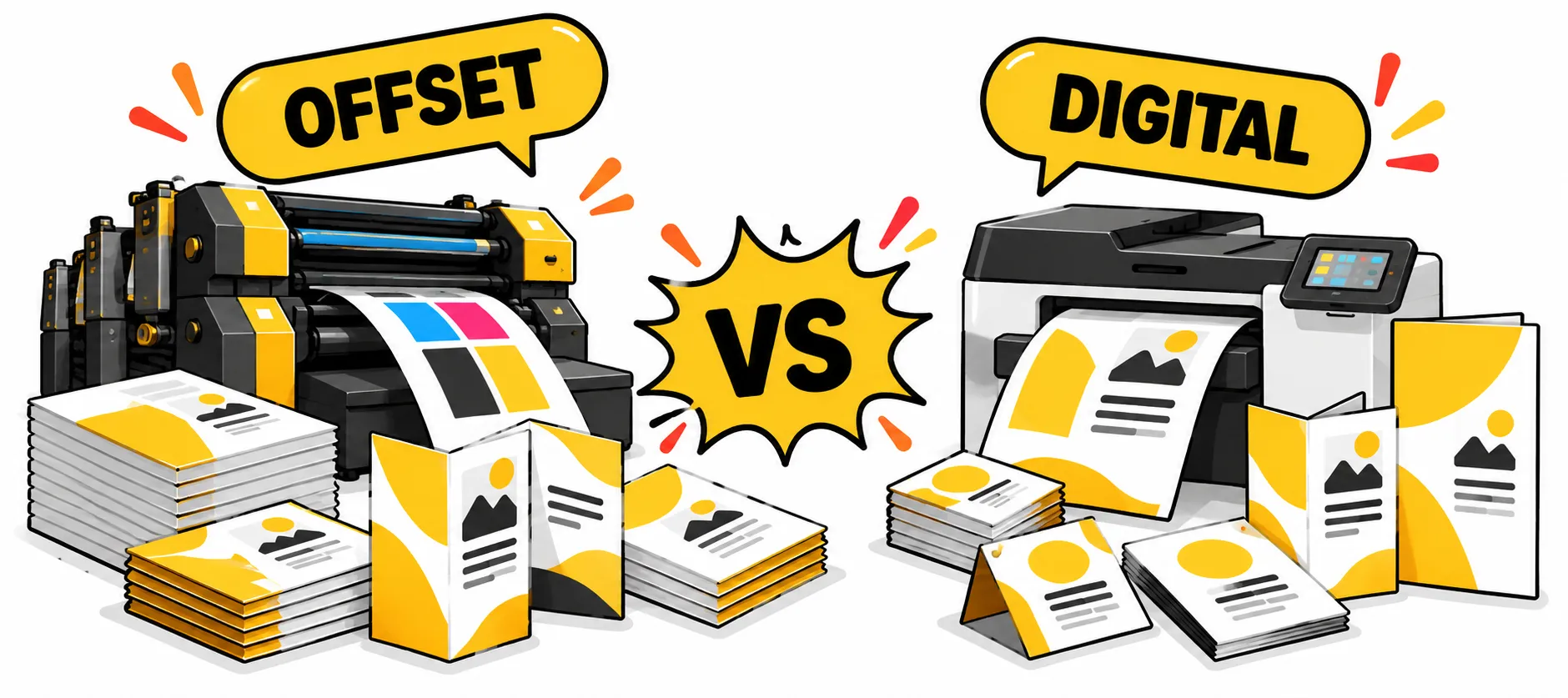
If you've ever tried to get something printed and found yourself caught between two quotes – one from a traditional press and one from a modern print shop – with no idea why they're priced so differently, this article is for you.
The difference between these two commercial printing methods is not just technical. It's a decision about what you're printing, how many you need, how fast you need them and which quality matters most to your brand. Get it right and you save money without compromising on output. Get it wrong and you'll either overspend on a short run or under-deliver on a large one.
01 How Offset Printing Actually Works
Offset printing is the backbone of commercial production as we know it. The process uses metal plates, one for each colour in the CMYK spectrum, onto which the image is chemically transferred. Ink rollers apply liquid ink to these plates, which then transfer (or "offset") the image onto a rubber blanket, which in turn presses it onto the paper. It's a beautifully engineered process that's been refined over more than a century.
The result is exceptional accuracy and colour consistency across thousands of sheets. Because the ink is applied as a true liquid, not fused with heat or fixed with toner, it sits cleanly on the paper surface and produces rich, deep solid colours and smooth gradients that are genuinely difficult to replicate through other methods at high volume printing scales.
What makes offset the industry benchmark?
- Pantone colours: Exact brand colours, reliably reproduced every time.
- Superior colour depth: Rich, vibrant results on solid blocks and large areas of colour.
- Substrate versatility: Ability to work across a vast range of paper stocks, packaging substrates and speciality surfaces.
- Economies of scale: Cost per piece drops dramatically at high volumes and the economics only improve with scale.
- Special finishes: Seamless access to spot UV, embossing, foil stamping and more.
How the Press Works: A lithographic press operates by keeping oil-based ink and water in careful balance on the plate surface. Ink adheres only to the image areas; water repels it from the non-image areas. This separation is maintained at high speed across thousands of sheets per hour, giving offset printing its legendary consistency. It's elegant chemistry working at an industrial scale.
The trade-off is setup time and cost. Each job requires new plates to be made, the press to be calibrated and a proofing run to verify colour before production begins. For smaller quantities, these fixed overheads make the process relatively expensive per unit, which is why it's almost always the wrong choice under 500 copies and becomes progressively more economical as volume increases.
02 How Digital Printing Changed the Game
Modern digital printing disrupted the economics of smaller runs entirely. Unlike offset, there are no plates, no lengthy preparation and no minimum quantities. Your file goes directly from screen to press and production begins almost immediately. For businesses that need 50 brochures, 100 flyers or a set of personalised direct mailers, digital printing is not just faster; it's the only sensible choice.
Contemporary digital presses use either toner-based (electrophotographic) or inkjet methods to lay down colour. Toner printing uses heat fusing to fix dry particles onto the paper surface. High-end inkjet systems fire microscopic droplets with remarkable precision and are increasingly capable of matching traditional press quality, even on large-format and wide-format work.
Where digital printing wins outright:
- Short run printing: 10 to 500 copies without inflated per-unit costs.
- Variable data printing: Each piece can carry a different name, address or personalised message.
- Fast turnaround: Same-day printing and next-day delivery are genuinely achievable.
- No plate costs: What you see in the proof is what gets printed.
- Easy iteration: Design changes cost time, not plate fees.
The limitation shows up most at large volumes and in colour-critical work. At high quantities, the per-piece cost is higher than with a traditional press. And while colour reproduction has improved dramatically, achieving Pantone colour-accurate results and the ink depth you get from a lithographic process still favour offset for certain brand-critical applications.
03 The Head-to-Head — Offset vs Digital Printing Compared
Here's where most guides get vague. Let's be specific. This offset vs digital printing comparison covers the factors that actually matter when you're making a print decision—not theoretical capabilities but practical realities for businesses placing real orders.
| Factor | Offset | Digital |
|---|---|---|
| Setup time | 2–5 days (plate-making, calibration) | Hours — file-to-press turnaround |
| Setup costs | Higher — plates made per job | None — no plates required |
| Cost at low volume | Digital wins — fixed setup cost kills unit economics | Clear advantage below 500 units |
| Cost at high volume | Offset wins — cost per piece falls sharply | Stays relatively flat; no bulk discount |
| Colour consistency | Offset wins — Pantone matching, liquid ink depth | Good for most uses; slight variation run to run |
| Turnaround time | 3–7 working days typical | Digital wins — same-day or next-day possible |
| Variable data | Not practical — same content every sheet | Digital wins — personalised per piece |
| Paper & substrate range | Offset wins — heavyweight paper, synthetic substrates, packaging | Good range, some limitations at extremes |
| Special finishes | Offset wins — foil, spot UV, embossing more accessible | Limited; improving with newer presses |
| Minimum quantity | Typically 500+ to justify setup | No minimum; 1 copy possible |
| Sustainability | More waste in makeready and setup | Print only what you need |
04 The Right Method for the Right Job
The most useful question to ask is not "Which method is better?" It's "Which is better for this specific job?" Here's how that plays out across the most common products businesses order.
Choose Offset Printing For The Following:
- Magazine and newspaper production at volume.
- Catalogues for large product ranges.
- Packaging — folding cartons and custom boxes.
- Brochure printing in runs of 1,000+.
- Booklets for annual reports or lookbooks.
- Presentation folders with premium finishes.
- Brand materials requiring Pantone colour accuracy.
- Large-format work on speciality substrates.
- Sales mailers and newsletters in bulk.
Choose Digital Printing For The Following:
- Business cards and startup stationery for small runs.
- Flyers for local campaigns — under 500.
- Event tickets with variable numbering.
- Personalised direct mailers and greeting cards.
- Brochure printing for testing designs before committing to a larger run.
- Urgent jobs with same-day printing requirements.
- Short-run postcards and promotional cards.
- Posters in limited quantities.
- Any job where content changes per recipient.
Print Insight: Most established commercial printing providers now run both types of equipment under one roof, which means you don't need to choose a vendor based on the method. Choose based on quality, reliability and communication, then let them guide you to the right process for each job.
05 The Cost Conversation — Where the Numbers Actually Land
For quantities under 500 units of a standard A4 brochure, digital printing will almost always be more economical, sometimes significantly so. Plate-making, press calibration and makeready waste typically add a fixed overhead to any offset printing job, regardless of quantity. When you spread that over 100 copies, the cost per piece is punishing. Spread it over 5,000 copies and it becomes negligible.
The crossover point where offset printing becomes more economical typically sits between 500 and 1,000 units for standard formats like A4 brochures and flyers. For packaging and folding cartons, offset almost always wins at any significant volume because of the substrate flexibility and colour depth required.
How to think about print budget decisions:
- Under 250 units of anything: Go digital, no question.
- 250–1,000 units: Get quotes from both; compare total cost, not just unit price.
- 1,000+ units: Offset almost always wins on cost per piece.
- Colour-critical brand work regardless of volume: Consider offset for Pantone color consistency.
- Urgent jobs needing same-day printing or next-day turnaround: Digital is your only practical option.
Bulk Discounts: Both approaches offer volume discounts, but they work differently. With offset, the big saving comes from spreading the fixed setup cost over more units. With digital, discounts are smaller and more linear. For large, recurring volumes, establishing a relationship with an offset printer and committing to regular runs can yield meaningful price advantages over time.
06 Hybrid Printing — The Best of Both
Here's something most people don't consider: you don't always have to choose one or the other. Combining both methods within a single project is an increasingly practical approach for businesses that need both scale and personalisation.
A common example: a corporate campaign that needs 10,000 base brochures produced affordably via offset printing, but each is personalised with an individual recipient's name, company and a unique QR code through digital overprinting. The offset press handles the heavy lifting on colour and volume; variable data printing handles the personalised layer on top.
Similarly, businesses launching new products often use a short run printing approach to produce proofing copies and early samples before committing to full high-volume printing production. This catches design errors before they're multiplied across thousands of sheets, saving far more money than the proof run costs.
When a combined approach makes sense:
- Direct mail campaigns requiring personalisation at volume.
- Loyalty cards, event tickets or gift vouchers with unique codes.
- Sales mailers combining a standard brand message with personalised details.
- Test runs before committing to large-scale production.
- Annual reports where some pages are standard and others variable.
07 Substrates, Finishes & What Each Method Can Handle
Not all print jobs are on standard A4 paper. And the choice in the offset vs digital printing decision often comes down not just to cost and volume, but to what the job is printed on and what finish it needs.
Offset printing handles heavyweight paper, cardstock, synthetic substrates and even some plastic applications. For packaging work on folding cartons or for uncoated or textured stocks, it often produces superior results.
Modern inkjet systems have expanded their substrate range significantly. For most standard paper types such as matte, glossy and standard cardstock, contemporary digital printing equipment performs beautifully. The gap between the two methods on everyday paper stocks has narrowed considerably over the past decade.
Special finishes — what's accessible where:
- Spot UV coating: Available with both methods, but more commonly associated with offset workflows.
- Foil stamping: Easier to integrate in offset workflows.
- Embossing and debossing: Post-press process, compatible with both methods.
- UV drying: Used in both inkjet and traditional presses to cure inks instantly.
- Matte and glossy lamination: Available across both; the choice of paper stock matters more than the print method.
08 Quick Decision Guide — Find Your Answer in 60 Seconds
Still unsure which method is right for your next job? Answer these questions and the right choice will become clear.
Offset or Digital? — Your Quick Decision Framework:
- Need fewer than 500 copies? → Go Digital
- Need more than 1,000 copies? → Go Offset
- Need same-day printing or next-day delivery? → Go Digital
- Does each piece need personalised content via variable data printing? → Go Digital
- Is Pantone colour accuracy critical to your brand? → Go Offset
- Printing packaging, folding cartons or speciality substrates? → Go Offset
- Is this a proof run before a larger, high-volume printing order? → Go Digital
- Need premium special finishes like foil or spot UV at scale? → Go Offset
- Ordering between 500 and 1,000 units? → Get both quotes
- Is minimising waste a priority? → Go Digital
The Shortcut: If you're working with a commercial printing provider that runs both types of equipment, share your brief directly on quantity, timeline, budget and what the end product needs to do. A good print partner will recommend the right approach without pushing you toward a more expensive option.
There Is No Universal Answer — Only the Right One for Your Job
Offset printing and digital printing are not competitors in the way the question implies. They're complementary with different strengths, different economics and different sweet spots. The businesses that get the most value from their print spend are the ones that understand which tool to reach for and when.
Offset printing built the publishing industry, the packaging industry and the commercial printing world as we know it. Digital printing democratised the craft, giving small businesses access to quality materials without minimum order anxiety. Both are excellent. Neither is universally better.
What matters is this: know what you're printing, know how many you need, know when you need it, and work with a printer who gives you an honest answer. The best method is always the one that serves your specific job, your specific timeline and your specific budget without compromise where it counts.
Frequently Asked Questions about Offset vs Digital Printing
Need Help Choosing Between Offset & Digital?
Let's discuss your project, run size, and timeline. Print Monster Chennai offers both high-volume offset and rapid digital printing under one roof with transparent pricing.

