
Best Paper Types for Professional Printing
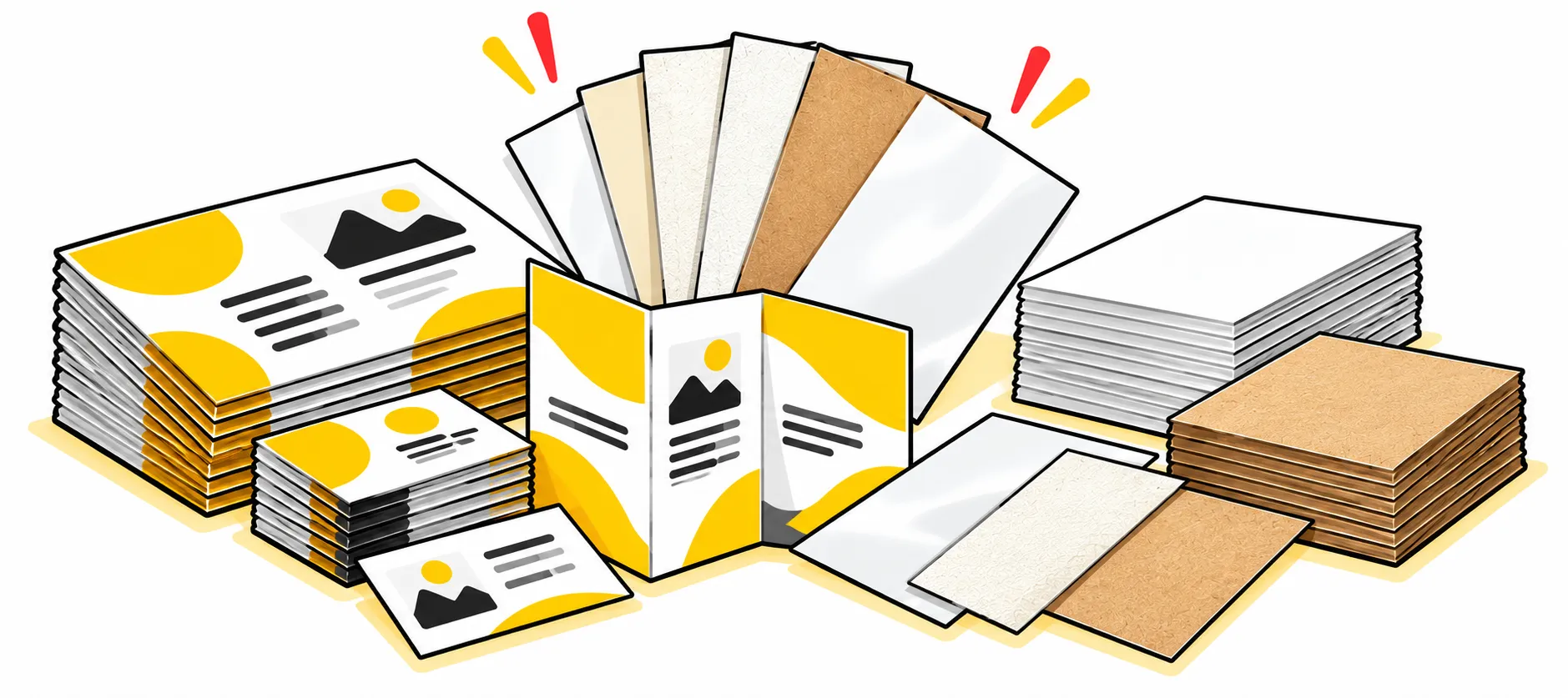
Your complete guide to weight, finishes, coated vs uncoated, cardstock, packaging and more so every print job comes out exactly right.
Walk into any print shop or open any supplier catalogue and you'll be confronted with a wall of choices. Glossy or matte? Coated or uncoated? 80 GSM or 300 GSM? Cardstock or paper? Satin or silk? If you've ever stared at these options and felt completely lost, you're not alone.
Most people know what they want their printed piece to look like. What they don't know is which stock will actually get them there. And that gap between intention and execution is exactly where jobs go wrong — colours that look muddy, cards that feel flimsy, brochures that bleed through or photos that lack depth.
This guide cuts through the confusion. Whether you're ordering business cards, brochures, packaging or large-format prints, you'll come away knowing exactly what to ask for and why.
of print quality is determined before ink touches paper
of consumers judge brand quality by how printed material feels
higher brand recall for premium stock vs standard options
01 Understanding GSM — The Foundation of Paper Weight
Before you can choose the right stock, you need to understand GSM. It's the single most important number in printing and yet one of the most commonly misunderstood — this is paper weight explained in its most practical form.
What does GSM mean?
What is GSM in paper? GSM stands for Grams per Square Metre. It is a standardised measure of weight and specifically, how much one square metre of that sheet weighs in grams. The higher the number, the heavier, thicker and generally more premium the material feels. It is the global standard used by commercial operations in India and worldwide.
GSM vs LB
If you're sourcing internationally or working with suppliers in North America, you'll also encounter weight described in LB (pounds). The LB system measures the weight of 500 sheets at a base size that varies by paper type, making it less intuitive. For most professional work in India, GSM is the standard. Here's a quick reference:
| GSM Range | Approx. Weight (500 Sheets) | Typical Commercial Use |
|---|---|---|
| 60–75 GSM | 7.3 - 9.1 kg | Newsprint, draft printing, lightweight forms |
| 80–90 GSM | 9.1 - 10.9 kg | Office paper, invoices, everyday documents |
| 100–120 GSM | 12.7 - 14.5 kg | Letterheads, flyers, light brochure inserts |
| 130–170 GSM | 15.9 - 20.4 kg | Brochures, product catalogues, magazines |
| 200–250 GSM | 24.5 - 30.4 kg | Booklet covers, presentation folders, heavy flyers |
| 300–400 GSM | 36.3 - 49.9 kg | Business cards, luxury invitations, retail tags |
| 400+ GSM | 50 kg+ | Luxury rigid cards, thick packaging inserts |
Weight at a Glance — Quick Rule of Thumb
- Under 100 GSM: Writing and everyday documents. Lightweight and economical.
- 100–170 GSM: The brochure zone. Substantial enough to feel professional, flexible enough to fold cleanly.
- 200–300 GSM: Cover material. Used for book covers, folder covers, and thick flyers.
- 300 GSM and above: Card territory. Business cards, luxury invitations, and premium packaging inserts.
02 Coated vs Uncoated — The Most Important Decision
If GSM is about weight, this is about performance. Understanding coated vs uncoated paper is the single choice that affects how your colours look, how your text reads, how the material feels in hand and, ultimately, how your brand comes across.
What is coated stock?
Coated paper has a surface treatment, a layer of clay-based or polymer coating applied during manufacturing. This seals the fibres, creating a smooth, non-absorbent surface. When ink is applied, it sits on top rather than being absorbed. The result: sharper detail, more vibrant colour and a more polished appearance.
This is the standard choice for colour-rich work. Think magazines, brochures, product catalogues and high-quality photography prints. If your design contains rich imagery, gradients or brand colours that need to stand out, a coated surface is almost always the right call.
What is uncoated stock?
Uncoated paper has no surface treatment. The fibres are exposed, which means ink absorbs directly into the sheet on contact. This gives it a natural, tactile quality — it's what you write on with a pen, the material used for letterheads, books, notepads and stationery.
Because ink spreads slightly when absorbed, this option is not ideal for fine photographic detail or highly saturated colour work. However, it's excellent for text-heavy documents, creates a more organic feel for certain brand identities and is the preferred choice wherever the surface needs to be written on.
| Factor | Coated Stock | Uncoated Stock |
|---|---|---|
| Ink behaviour | Sits on surface — sharper reproduction | Absorbed into fibres — slight spread |
| Colour vibrancy | High — rich, punchy, saturated | Moderate — softer, more muted |
| Photography | Excellent detail and contrast | Not recommended for fine photos |
| Writability | Poor (liquid ink smears easily) | Excellent (pen and pencil receptive) |
| Tactile feel | Smooth, sleek, polished | Natural, warm, organic texture |
| Best for | Brochures, catalogues, cards, photos | Letterheads, books, notepads, forms |
| Relative cost | Slightly higher | Generally lower baseline |
Real Talk: Neither option is universally better. The question is always, 'What are you printing and what impression do you want it to make?' A law firm's letterhead should be uncoated. A luxury spa's brochure should be coated. Using both for different materials within a brand kit is not only acceptable, but it's also a smart move.
03 Finishes Explained — Gloss, Matte, Satin and Beyond
Within coated stock, there are multiple paper finishes for printing. This is where the gloss vs matte paper debate lives and it's a genuinely important distinction that affects both appearance and usability.
Gloss
Gloss is the shiniest, most reflective option. It maximises colour vibrancy and makes images look crisp and vivid. It's the standard choice for magazines, product brochures, retail flyers and any material where photography is central to the design.
The trade-off: it shows fingerprints easily, can produce glare under certain lighting and doesn't feel as premium to the touch as flatter alternatives. It can also be harder to read in direct light.
Matte
Matte has a flat, non-reflective surface. It's softer in appearance, easier to read under all lighting conditions and feels more sophisticated in hand. It's the preferred choice for brand-conscious businesses — it communicates quality and intentionality in a way gloss simply doesn't.
The trade-off: colours appear slightly less vivid, though modern production technology has largely closed this gap. A quality matte finish from a professional supplier will still deliver excellent colour accuracy.
Satin (Silk Finish)
Satin, sometimes called 'silk', sits between the two. It offers better colour reproduction than matte with less reflectivity than gloss. Many design professionals consider it the best all-round option because it combines visual quality with tactile comfort.
When choosing between satin and matte as part of your paper finishes for your printing decision, consider the end use. Satin works beautifully for brochures, portfolios and premium flyers. Matte is often preferred for business cards, book covers and anything handled frequently.
Finishes At a Glance:
- Gloss: Maximum vibrancy, high sheen. Best for photography-heavy work, retail flyers, and magazines.
- Satin / Silk: Balanced — good colour, low glare, premium feel. Best all-rounder for brochures and mid-range marketing materials.
- Matte: Non-reflective, sophisticated, easy to read. Best for business cards, corporate branding, anything touched frequently.
- Soft-Touch Matte (Velvet): Ultra-premium, velvety texture. Best for luxury brands, top-tier cards and high-end packaging.
Speciality Finishes:
- Textured: Textured stock has a physical surface pattern; linen, felt, laid or canvas weaves are common options. Used predominantly for luxury stationery, invitations, high-end business cards and brand identity materials where differentiation matters. It communicates handicraft and exclusivity instantly.
- Metallic: Metallic stock has a shimmering, foil-like surface that catches the light. Used for premium packaging, gift wrap, luxury product labels and special edition materials. It's not typically used for text-heavy documents; it's a statement material for momentous moments.
- Water-Resistant Options: Synthetic or specially coated sheets that resist moisture are essential for outdoor signage, hospitality menus, product labels exposed to liquid and packaging for food or cosmetics. These are available in various finishes and weights; consult your supplier for the right specification.
04 Choosing by Use Case — What to Specify for Every Job
Business Cards
Business cards are one of the most tactile branded items you'll ever produce. They need to feel substantial from the first moment someone picks them up. The wrong choice undermines an otherwise excellent design.
The best paper for printing business cards is typically 350–400 GSM coated stock, finished with matte laminate, gloss laminate or soft-touch laminate. For truly premium results, consider spot UV on a matte base — this creates a contrast between the flat surface and glossy raised elements (logos, names) that's genuinely striking.
- Standard: 350 GSM coated, matte or gloss laminate — professional, clean, accessible cost.
- Premium: 400 GSM soft-touch matte with spot UV — creates a luxury feel and memorable texture.
- Eco-conscious: FSC-certified or recycled stock at 350 GSM — the same professional result with sustainability credentials.
- Avoid: Anything below 300 GSM. Thin cards feel cheap and undermine brand perception instantly.
Brochures
Brochure stock needs to balance two requirements: it must fold cleanly without cracking, and it must display images and text beautifully. The sweet spot is typically 130–170 GSM coated in matte or satin.
- Covers (for booklet-style formats): 250–300 GSM coated, laminated.
- Internal pages: 130–150 GSM coated matte or satin.
- Tri-fold or bi-fold: 150–170 GSM — substantial enough to feel quality, light enough to fold well.
- Budget option: 120 GSM coated — the lightest weight that still reads as professional.
Packaging
Packaging spans a wide range of specifications depending on the product and purpose. Custom options for small businesses typically use kraft (natural brown, 80–120 GSM), coated board (250–400 GSM for boxes) or speciality sheets for wrapping and tissue.
For product labels specifically, the material must adhere cleanly to surfaces and, depending on the product, be resistant to moisture, heat or abrasion. Label work for cosmetics, food and beverages often requires water-resistant or specially coated stock with a strong adhesive layer. Always specify end-use conditions to your supplier before ordering.
Pro Tip — FSC-Certified Paper: 'FSC-certified paper' stands for 'Forest Stewardship Council certification'. These materials are sourced from responsibly managed forests, where trees are harvested in a way that maintains biodiversity, worker rights and ecosystem health. For brands communicating sustainability values, specifying FSC-certified paper is a credible, verifiable signal to customers. Many bulk suppliers in India now offer this at comparable prices to standard options.
05 Opacity and Brightness — The Specs Most People Ignore
Two specifications are frequently overlooked: opacity and brightness. Getting these wrong can ruin an otherwise well-designed job.
Opacity
'Opacity' refers to how much light passes through a sheet or, more practically, how much the content on one side shows through to the other. High opacity (90%+) means print on one side stays on one side. Low opacity produces ghosting from the reverse, a problem you've certainly noticed in cheap magazine inserts.
For any double-sided work such as cards, brochures, flyers, and letterheads, always specify high-opacity stock. Most professional coated materials at 130 GSM and above will naturally have sufficient opacity, but it's worth confirming with your supplier.
Brightness
Brightness measures how much light a sheet reflects, typically on a scale of 1 to 100. Higher brightness means whiter stock, which in turn means more vivid colour and higher contrast for black text.
Standard office paper typically measures around 85–90. Premium marketing stock usually starts at 92–96. For colour-critical or photography work, specify a brightness rating of 94 or above.
- 92+ brightness: Baseline standard for quality brochure and marketing work.
- 90%+ opacity: Essential for double-sided printing to prevent shadow show-through.
- 300 GSM minimum: Baseline threshold for business cards and rigid presentation collateral.
06 Cardstock vs Paper — Understanding the Difference
Cardstock vs paper is a distinction that's often blurred, but they refer to meaningfully different materials with different applications.
Lighter weight stock (under 170 GSM)
In printing terminology, this covers everything from standard office paper (80 GSM) to brochure weights (130–160 GSM). It's flexible, foldable and cost-effective.
Heavier stock / Cardstock (200 GSM+)
This refers to thicker, stiffer material, generally above 200 GSM, extending to 400+. Used for items that need to hold their shape: business cards, greeting cards, postcards, booklet covers, presentation folders and packaging inserts.
| Feature | Lighter Stock (under 170 GSM) | Heavier Stock / Cardstock (200 GSM+) |
|---|---|---|
| Flexibility | High — folds easily without cracking | Low to medium — holds rigid structure |
| Durability | Moderate — prone to creasing | High — resists everyday wear and tear |
| Best for | Brochures, flyers, stationery, letters | Business cards, covers, packaging inserts |
| Printing suitability | Offset or digital both work easily | Requires heavy-substrate press capability |
| Relative cost | Lower cost per sheet | Higher cost per sheet |
When sourcing from bulk suppliers or local operations in Chennai, always confirm whether quotes are by the sheet, ream (500 sheets) or kilogram and double-check the weight against your application before placing a large order.
07 Digital vs Offset — How the Print Method Affects Your Choice
Your stock selection is also influenced by the production process. The two primary commercial methods interact with the types of paper for printing differently.
Digital Production
Digital printing uses toner (laser) or inkjet technology to apply colour directly from a file. It's fast, cost-effective for shorter runs and requires no plates, making it ideal for small batches and personalised materials. It's widely available through most printing services in Chennai.
It works best with smooth, coated surfaces. Heavily textured sheets can cause adhesion issues with toner-based systems. Most standard matte and gloss coated options are optimised for this method.
Offset Production
Offset transfers ink from a plate to a rubber blanket and then to the sheet. It produces richer, more consistent colour, particularly for large runs and handles a wider range of materials, including uncoated and textured options, more reliably than digital.
For bulk runs (500 units and above), offset typically becomes more economical. If colour consistency across a large job is critical for brand materials, packaging or premium brochures, it's often the professional choice.
A Practical Note
The most economical option is standard 80 GSM uncoated bond, the kind used in office printers every day. It is entirely unsuitable for professional marketing materials.
For results that look genuinely professional without unnecessary cost, 120 GSM coated matte is the entry point for most marketing work. It's widely available across printing services in Chennai and produces results that read as considered and on-brand.
Trying to save money by going below this threshold almost always costs more in the long run through reprints, poor brand impression or materials that simply don't hold up.
08 Building Your Specification — A Practical Checklist
When briefing a local supplier or submitting an online order, being able to specify your requirements precisely saves time, prevents errors and ensures you get exactly the result you're looking for.
Your Specification Checklist:
- Weight (GSM): Specify the exact weight required. Don't accept "standard" without confirmation.
- Coated or uncoated: Confirm based on your design and whether the piece needs to be written on.
- Finish: Gloss, matte, satin/silk, soft-touch, textured or metallic — specify exactly.
- Brightness: Request 92+ for colour-critical work, 94+ for photography.
- Opacity: Specify 90%+ for any double-sided job.
- Sustainability certification: Request FSC-certified paper if environmental credentials matter to your brand or clients.
- Water resistance: Specify if the material will be exposed to moisture, outdoor conditions or food contact.
- Print method: Confirm digital or offset based on quantity and colour requirements.
Finding the Right Supplier
If you're based in Chennai, compare quotes from both digital and offset vendors before committing. Digital works best for runs under 500 units; offset becomes more economical at higher volumes.
For urgent requirements, same-day options are available from many local providers for standard formats and common stock types. Always confirm material availability before scheduling a fast-turnaround job.
For larger commercial runs, request a printed sample called a paper dummy or press proof before approving production. The difference between a specification on paper and the finished material in hand is often the difference between a good result and a great one.
The Bottom Line: Stock is Part of the Design
This is not a commodity decision. It's a design decision. The material you choose affects how your colours render, how your text reads, how your brand feels in someone's hands and ultimately, the impression your business makes before a single word is processed.
A brochure printed on the wrong stock can make a beautifully crafted design look ordinary. The right choice, the right weight, the right finish, and the right coating can make even a simple design look considered and premium.
So whether you're briefing a local supplier for the first time, building out a full suite of brand print materials, or simply trying to understand paper weight explained, when your printer says "150 GSM coated matte satin", you now have everything you need to make the right call.
Print with intention. Choose your materials like it matters. Because to the people who receive them, it does.
Frequently Asked Questions about Paper Types
Bring Your Designs to Life on the Perfect Paper Stock
Unsure whether 350 GSM matte or 400 GSM velvet cardstock is right for your project? Talk to the paper and printing specialists at Print Monster Chennai for swatches and instant quotes.

